Overthinking & Racing Thoughts

We’ve already talked a lot about anxiety, stress, burnout, and taking care of your mental health. But today, we’re getting a little more specific.
You’ve probably heard someone say, “I’m overthinking it,” or “My mind is racing.” Maybe you’ve even said it yourself. We use these phrases so often that sometimes we forget to think about what they actually mean.
What does overthinking really feel like? What are racing thoughts? Why does your brain keep going even when you WANT it to stop? And most importantly... how do you slow it down?
Today, we’re breaking down the experience of overthinking so you can recognize when it’s happening and learn how to bring your mind back down to a more manageable speed.
What Does Overthinking Actually Look Like?
Overthinking is more than simply thinking about something for a long time. It usually happens when your thoughts begin going in circles without actually helping you solve the problem.
It can sound like:
“Why did I say that?”
“Do they think I’m annoying?”
“What if I mess this up?”
“Maybe I should have done something differently.”
“What if this happens... and then THIS happens?”
“They haven't answered me. Did I do something wrong?”
“What if I make the wrong decision?”
Sometimes overthinking focuses on the past.
You replay a conversation from earlier that day. Then you remember something embarrassing you did three years ago. Suddenly, your brain is analyzing things that you cannot go back and change.
Other times, overthinking focuses on the future.
You imagine one thing going wrong, which leads to another thing going wrong, which leads to another. Before you know it, your brain has created an entire situation that hasn't even happened. Overthinking can make you feel like you're solving a problem when you're actually stuck in a loop.
What Are Racing Thoughts?
Racing thoughts can feel a little different.
Instead of getting stuck on one thought, it may feel like your brain is moving from one thought to another... to another... to another.
You might be lying in bed thinking:
I need to finish that assignment tomorrow. Wait, did I respond to that text? I forgot to wash my uniform. What time do I need to wake up? I really need to start saving money. Why did I say that weird thing earlier? I should check my phone. Wait... what was I thinking about?...
Your body may be completely still, but your brain feels like it's running. You may have trouble concentrating, falling asleep, making decisions, or even explaining what you're thinking because there are too many thoughts happening at once.
Why Can't I Just Stop Thinking About It?
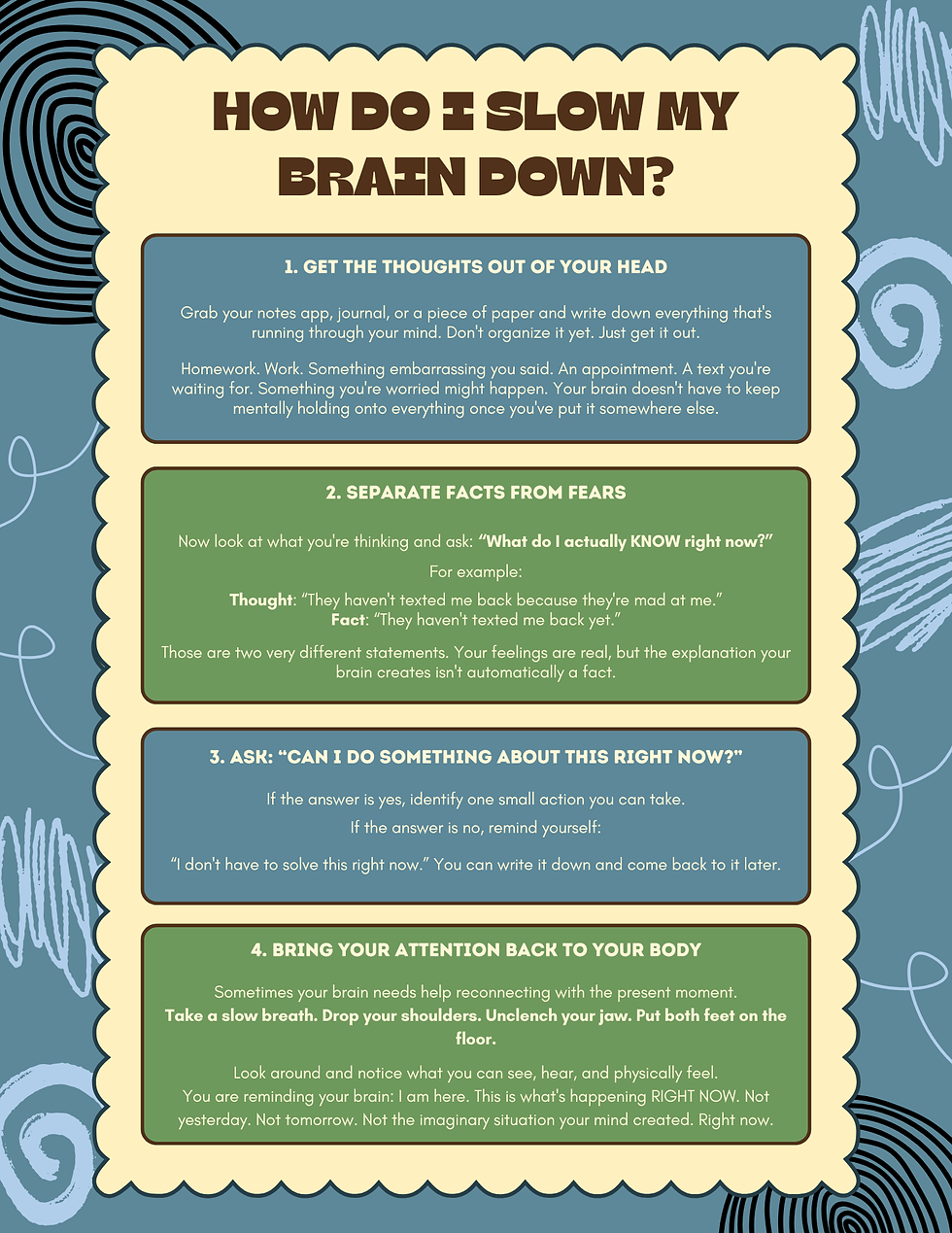
If you've ever told yourself, “Just stop thinking about it,” you probably noticed that it doesn't work very well. That's because trying to FORCE a thought away can sometimes make you focus on it even more.
Instead of fighting every thought that enters your mind, the goal is to learn how to notice your thoughts without automatically following every single one of them.
A thought can exist without needing your immediate attention. Think of your thoughts like notifications on your phone. Some notifications are important and need a response. Some can wait until later. And some don't need your attention at all.
You don't have to click every notification your brain sends you.
When Overthinking Starts Taking Over...
Everyone overthinks sometimes. It becomes a bigger problem when it regularly interferes with your everyday life.
You may notice yourself:
Replaying conversations repeatedly
Constantly asking other people for reassurance
Struggling to make simple decisions because you're afraid of choosing wrong
Creating worst-case scenarios
Losing sleep because your mind won't slow down
Reading deeply into texts, facial expressions, or someone's tone
Having difficulty concentrating on what's happening right now
Avoiding things because you've thought about everything that could go wrong
Recognizing the pattern is important because you can't practice changing a pattern you haven't noticed yet.

Final Reminder…
Overthinking can make a small thought feel like a huge problem. Not every thought needs an answer, a solution, or your attention. Sometimes the best thing you can do is notice the thought, check the facts, and let it pass.
You don’t have to figure everything out right now. Slow down, focus on what you know instead of what you fear, and give your brain permission to rest.


Comments